Guide
Building an Off-Grid Sauna
An off-grid sauna brings everything itself. This guide covers wood heat, passive ventilation, solar lighting, no-excavation foundations and the remote-site logistics that make a serviceless sauna work.
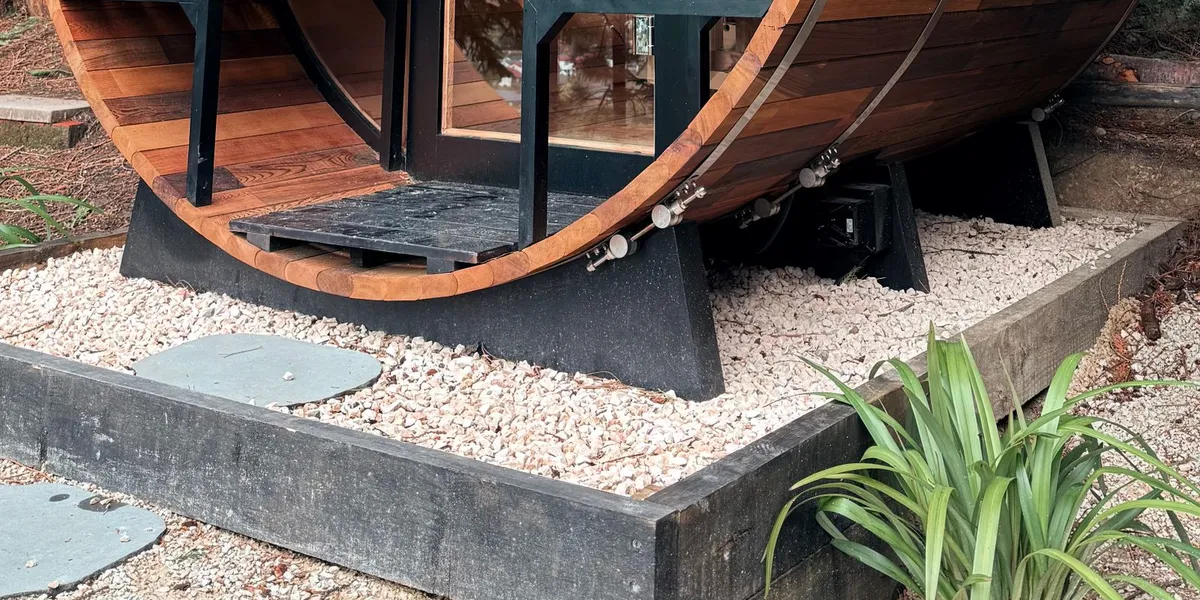
An off-grid sauna has to bring everything itself: its heat, its air movement, and — if it has any — its light. Built for woodland, remote-cabin and other serviceless sites, it trades the convenience of mains power for genuine self-reliance. Done well, it needs almost nothing from the outside world. Done carelessly, it either fails to perform or cuts corners it should not. This guide covers how to plan one properly.
Wood heat, because it needs no power
The defining choice is settled by the setting: an off-grid sauna is wood-fired, because a stove needs no electricity at all. That is why every off-grid, woodland and remote profile in the archive uses wood heat. The design then centres on the stove rather than a circuit — the chimney, hearth and clearances become the critical details, along with somewhere to store seasoned fuel. Wood also suits the character of a remote lot, where tending a fire is part of the pleasure rather than a chore.
Passive ventilation, no fans
With no power, the ventilation is passive — a low inlet near the stove and an adjustable high outlet, driven by convection and the stove’s draw. There are no fans to fail, which is exactly why it suits a serviceless site, but it must be tuned: the stove and vents are balanced by hand for the room. The ventilation guide covers the principle. A well-balanced passive system keeps the air fresh and the bathing comfortable without a watt of electricity.
Lighting and small loads, off-grid
The one place power helps is lighting, and it is easily provided off-grid. A small solar panel and a battery, a rechargeable power station, or simple battery lanterns can run low-voltage LED lighting indefinitely — kept entirely separate from the wood heat. The archive’s solar-ready profile is drawn around this idea, with a roof oriented to carry panels for the small electrical loads. The key point, from the lighting guide, is that solar sizing is about lighting and controls, not heating — do not confuse the two.
Foundations without machinery
A remote site is often reached without heavy equipment, so the foundation should need no excavation. A gravel pad or ground screws suit most off-grid builds, with piers where conditions allow. The base still has to keep the floor lifted, frost-stable and drained — off-grid changes the method, not the requirements.
Local materials and simple construction
Off-grid builds favour simplicity and local materials — timber that can be milled on or near the site, and a design that goes up with basic tools. Economical spruce and, for a mass-timber look, stacked logs suit this well. The construction is deliberately straightforward so it can be built far from a lumberyard.
Do not lower the standards
The most important thing off-grid does not change is the building standard. An off-grid sauna still needs a proper insulated envelope and continuous vapour barrier to perform in extreme cold — several off-grid profiles carry a high-performance envelope for exactly that reason. And it still needs the relevant permits and inspections; being remote does not exempt a wood stove from fire code or a structure from local rules. Off-grid means bringing your own services, not skipping the fundamentals.
The logistics
Finally, plan the logistics honestly: how materials and the stove reach the site, how the build is inspected, and how you will resupply fuel. Remote sites reward preparation — a design that arrives in manageable pieces, a realistic schedule, and services (fire, ventilation, lighting) that stand alone. Get those right and an off-grid sauna delivers the rarest thing a sauna can offer: complete independence, a quiet fire in the trees, and a hot room that owes nothing to the grid.
Frequently asked questions
How is an off-grid sauna heated?
By a wood stove, which needs no electricity at all. This is why every off-grid, woodland and remote profile in the archive is wood-fired rather than electric.
How does an off-grid sauna ventilate without power?
With passive ventilation — a low inlet near the stove and a high outlet driven by convection and the stove's draw. There are no fans, so the vents and stove are balanced by hand.
Can an off-grid sauna have lighting?
Yes — a small solar panel and battery, or a rechargeable lantern, can run low-voltage LED lighting entirely separately from the wood heat. Some profiles use a solar-ready roof for this.
What foundation suits a remote site?
A gravel pad or ground screws that need no excavation gear, or piers where conditions allow. The base should suit a site reached without heavy machinery.
Does off-grid mean I can skip insulation and permits?
No. An off-grid sauna still needs a proper insulated envelope and vapour barrier to perform in the cold, and it still needs the relevant permits and inspections. Off-grid changes the services, not the standards.
Added to the catalogue on . Catalogue Editorial Team at Outdoor Sauna Index.