Guide
Outdoor Sauna Roof Types Compared
The roof is a structural and thermal decision, not just a look. This guide compares the five roof forms in the archive by snow handling, build difficulty, ceiling volume and suitability.
In snow country the roof does two demanding jobs at once: keep the heat in and deal with a serious weight of snow. Choosing the roof form is therefore a structural and thermal decision, not merely a stylistic one, and it ties directly into how the sauna is built and how big a heater it needs. The archive uses five roof forms; here is how they compare and where each belongs.
Snow: shed it or carry it
There are two valid strategies for snow, and the roof form embodies the choice. A steeper pitched roof sheds snow, keeping the load low — but it drops that snow somewhere, so plan where, and keep it off the door. A flat or low-slope roof carries the snow, which demands a stronger structure and reliable drainage but keeps the silhouette clean. Neither is wrong; they are different engineering answers to the same problem. The snow-load guide covers the structural side in depth.
The five roof forms
- Gable — the classic two-slope roof. Sheds snow readily from both sides, adds ceiling volume, and is forgiving to build. The archive’s default for cabins and traditional forms.
- Shed (single-pitch) — one slope. Simple and economical, sheds to the low side, and gives a lower ceiling on that side. Common on sheds and compact cabins.
- Mono-pitch — a pronounced single slope, often steeper, for a modern look that still sheds snow. Used on several modern profiles.
- Flat (warm flat roof) — a low-slope membrane roof over tapered insulation. Carries snow rather than shedding it, so it must be engineered for the load with proper drainage and parapet detailing. Advanced, and central to the cube and modern profiles.
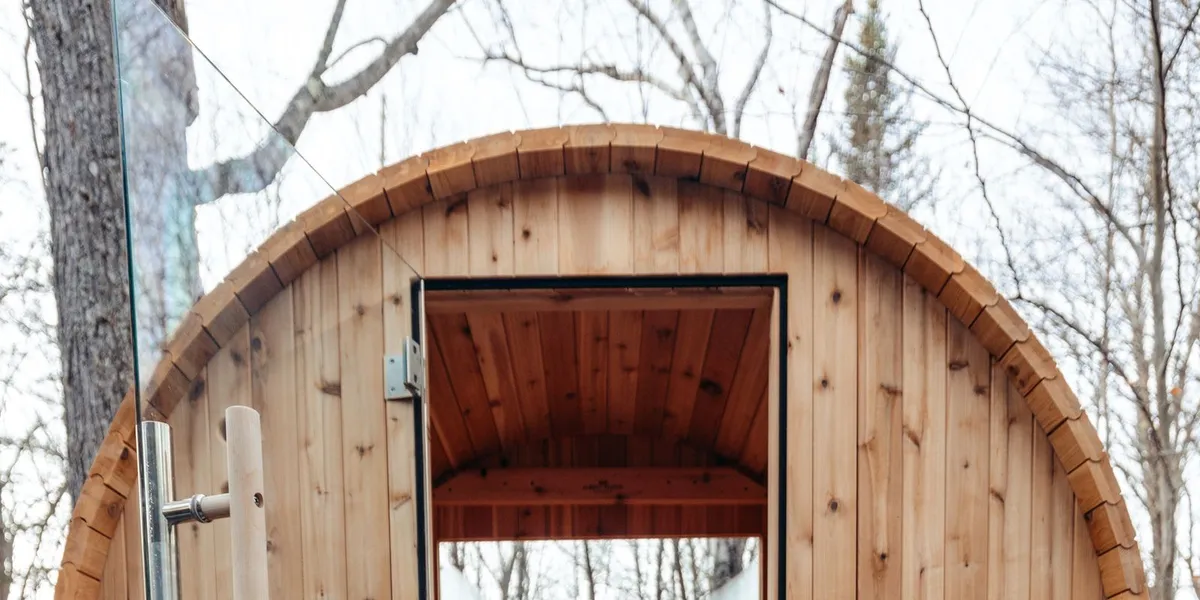
- Curved — the barrel form, whose rounded section sheds naturally and reduces the air volume above the bathers.
Roof form and the heater
The roof is not only structural — it sets the ceiling volume, and volume drives heater size. A gable adds height and air, nudging the heater class up; a flat or low roof keeps the volume tight and efficient; a curved barrel roof deliberately minimises the volume over the bathers, which is part of why barrels warm quickly. This is one reason the archive lists roof type alongside heater class — they are related decisions.
Overhangs earn their keep
Whatever the form, generous overhangs push shed snow and meltwater clear of the walls, the door and the foundation. In a wet, freeze-thaw climate this protection matters as much as the roof covering itself, keeping water away from the parts most prone to rot. Skimping on overhangs to save a little material is a false economy.
Build difficulty by form
If buildability is a priority:
- Easiest: a simple gable or single-pitch shed roof — forgiving, well understood, achievable for an intermediate builder.
- Moderate: a steeper mono-pitch, mainly a matter of the taller wall and clean detailing.
- Advanced: the warm flat roof, an unforgiving membrane assembly where mistakes leak and rot, and which must be designed for the snow load. Best left to experienced builders — see the DIY vs professional guide.
Choosing a roof
Work from your climate and your build:
- Heavy snow and a simple build → a steep gable that sheds.
- A modern look you can still build sensibly → a mono-pitch.
- A crisp, contemporary silhouette and a professional builder → a warm flat roof engineered for the load.
- A quick, efficient, kit-style sauna → a curved barrel.
The roof ties together snow, structure, ceiling volume and heater size, so decide it early and in concert with the rest of the design. Every profile in the archive states its roof type so you can see, at a glance, which strategy it takes.
Frequently asked questions
Which roof sheds snow best?
A steeper pitched roof — a gable or a steep mono-pitch — sheds snow most readily. Flat and low-slope roofs can carry snow well but must be engineered for the load rather than relying on shedding.
Can a flat-roofed sauna handle a Canadian winter?
Yes, as a properly engineered warm flat roof rated for the local snow load, with drainage and parapet detailing. It is an advanced assembly, not a low-slope afterthought.
How does the roof affect heater size?
A gable adds ceiling volume — more air to heat — nudging the heater class up. A flat or low roof keeps the volume tight and efficient. Roof form ties into heater sizing as well as snow.
Do overhangs matter?
Yes. Generous overhangs push shed snow and meltwater clear of the walls, door and foundation, protecting the structure — valuable everywhere and essential in a wet freeze-thaw climate.
Which roof is easiest to build?
A simple pitched gable or single-slope shed roof is the most forgiving. Flat and warm-membrane roofs are advanced, unforgiving assemblies best left to experienced builders.
Added to the catalogue on . Catalogue Editorial Team at Outdoor Sauna Index.