Guide
Sauna Design Terminology
A reference glossary of the terms used throughout the archive, defined plainly so you can read any profile with confidence. Grouped by heat, structure, materials and site.
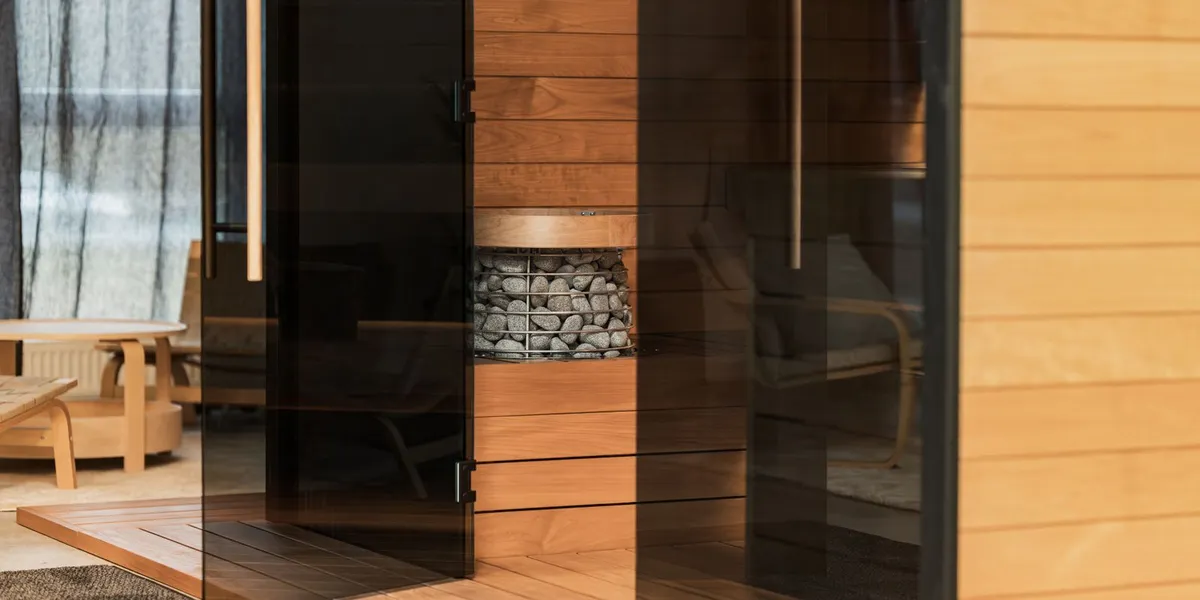
The archive uses a consistent vocabulary so that very different saunas can be compared on equal terms. This glossary defines those terms plainly, grouped by theme. Keep it open while you browse profiles.
Heat and the experience
- Löyly — the burst of steam and the wave of soft heat when water is thrown on the hot stones; the heart of the traditional sauna.
- Stone capacity — how much stone a heater or stove holds. More stone stores more heat and gives a softer, longer-lasting steam, but warms up more slowly; less stone heats fast and gives a sharper, shorter steam.
- Heater class — the approximate power (in kW, for electric) suited to a room’s volume, glazing and insulation. A planning band, not a specification.
- Warm-up time — how long the room takes to reach bathing temperature; lengthened by glazing, cold exposure and large stone loads.
Structure and envelope
- Envelope — the whole enclosing assembly of walls, roof and floor.
- Insulation level — how well the envelope resists heat loss, graded from uninsulated through cold-climate insulated to high-performance.
- Vapour barrier — a continuous, sealed layer (often foil) on the warm side of the insulation that stops humid air condensing inside the wall. Continuity is critical.
- Rainscreen — a ventilated cavity behind the exterior cladding that lets moisture drain and dry.
- Glazing level — the extent of glass, graded minimal → moderate → generous → panoramic.
- Roof type — the roof form: gable, flat, shed (single-pitch), mono-pitch, or curved (as on a barrel).
Materials
- Cedar — a stable, rot-resistant, low-resin premium sauna timber.
- Thermowood — heat-treated softwood prized for stability and dark tones.
- Aspen / alder — resin-free, cool-to-touch bench timbers.
- Resin — natural sap in some timbers (notably pine) that can weep at heat, making them unsuitable for benches.
- Thermal mass — a material’s ability to store heat; high in stone, concrete and solid log walls.
Site and foundation
- Frost line — the depth to which ground freezes in winter.
- Frost heave — the lifting of a structure when water in the soil freezes and expands; resisted by bearing below the frost line and by good drainage.
- Ground screws — steel piles driven below the frost line to carry the structure on point supports.
- Setback — the required distance between a structure and a boundary, shoreline or feature, set by local rules.
Program and layout
- Hot room — the heated sauna room itself.
- Changing room — a separate, usually tempered space to robe and store belongings.
- Cooling area / cooling deck — the space, often covered, for cooling between sessions.
- Dual-ready — designed to accept either an electric heater or a wood stove.
- Off-grid — designed to run with no mains power, on wood heat and passive ventilation.
Frequently asked questions
What does löyly mean?
Löyly is the burst of steam and the wave of heat produced when water is thrown onto the hot stones. It is central to the traditional sauna experience.
What is stone capacity?
The amount of stone a heater or stove holds. More stone stores more heat and gives a softer, longer-lasting steam, at the cost of a longer warm-up.
What is the difference between glazing levels?
The archive grades glazing from minimal (small window) through moderate and generous to panoramic (a full glazed wall). More glazing means more light and more heat loss.
What is a rainscreen?
A ventilated cavity behind exterior cladding that lets moisture drain and dry, protecting the structure.
What is the frost line?
The depth to which soil freezes in winter. Foundations that bear below it resist frost heave.
Added to the catalogue on . Catalogue Editorial Team at Outdoor Sauna Index.